How To Increase Shopify LTV (Customer Lifetime Value)
Learn how to increase Shopify LTV, improve retention, and generate more recurring revenue from every customer.
If you're trying to grow a Shopify store profitably, increasing Shopify LTV may be more important than generating more traffic. The stores that scale sustainably are not always the ones with the most customers—they’re the ones that generate the most value from each customer over time.
What is Shopify LTV?
Shopify LTV, or customer lifetime value, refers to the total amount of revenue a customer generates during their relationship with your Shopify store.
A customer who purchases once and never returns has a low lifetime value. A customer who repeatedly buys products, joins subscriptions, upgrades orders, and stays engaged for years has a high lifetime value.
Increasing Shopify LTV allows merchants to:
- Spend more on advertising profitably
- Increase recurring revenue
- Improve retention and repeat purchases
- Reduce dependence on constant customer acquisition
- Grow faster without increasing traffic
For many ecommerce brands, improving customer lifetime value is one of the highest ROI growth strategies available.
The Shopify Growth Trap Most Stores Fall Into
Most Shopify merchants focus almost entirely on acquiring new customers. They spend thousands on ads, influencers, SEO, and social media trying to increase traffic and conversions.
But there’s a major problem with this strategy:
Customer acquisition costs continue to rise across ecommerce. Competition is increasing, ad platforms are more saturated, and many stores are paying more than ever just to acquire a single sale.
Meanwhile, many stores completely ignore what happens after the first purchase.
The result is a dangerous cycle:
- Acquire customer
- Generate one order
- Lose customer
- Spend more money acquiring another customer
This creates fragile growth because the business constantly depends on new traffic instead of maximizing the value of existing customers.
The stores that grow sustainably understand a key principle:
Increasing Shopify LTV is often more profitable than increasing traffic.
Why Most Shopify Stores Have Low Customer Lifetime Value
To increase Shopify LTV effectively, you first need to understand why many stores struggle with retention and repeat purchases.
1. One-Time Purchase Mentality
Many Shopify stores are designed entirely around the first sale. Their marketing, product pages, and checkout flows focus on immediate conversion but fail to create long-term customer relationships.
Without retention systems in place, customers purchase once and disappear.
2. No Subscription or Recurring Revenue Strategy
Subscription models are one of the most effective ways to increase Shopify LTV because they transform one-time buyers into recurring customers.
Yet many merchants either:
- Never offer subscriptions
- Offer poor subscription experiences
- Lose subscribers due to high churn
Without recurring revenue, customer lifetime value becomes much harder to scale predictably.
3. Poor Post-Purchase Experience
Many brands stop engaging customers after checkout.
This creates missed opportunities for:
- Upsells
- Cross-sells
- Bundles
- Loyalty
- Retention campaigns
The post-purchase experience often determines whether a customer becomes loyal or disappears forever.
4. Lack of Personalization
Modern customers expect personalized experiences. Generic offers and one-size-fits-all recommendations often reduce engagement and repeat purchases.
Stores that personalize recommendations, subscriptions, and bundles typically generate stronger customer lifetime value over time.
5. High Subscription Churn
Many subscription-based Shopify stores struggle with churn. Customers cancel subscriptions voluntarily or lose them involuntarily through failed payments.
Even small churn rates compound dramatically over time and reduce overall Shopify LTV.
How To Increase Shopify LTV (Step-by-Step)
Increasing Shopify LTV requires building systems that maximize long-term customer value—not just initial conversions.
Step 1: Introduce Subscriptions and Recurring Revenue
One of the fastest ways to increase Shopify LTV is through subscriptions.
Instead of relying on repeat purchases manually, subscriptions automate recurring revenue and increase customer retention naturally.
Effective subscription strategies include:
- Subscribe-and-save offers
- Flexible delivery schedules
- Membership programs
- Consumable product subscriptions
Recurring revenue creates predictable growth and significantly improves lifetime value over time.
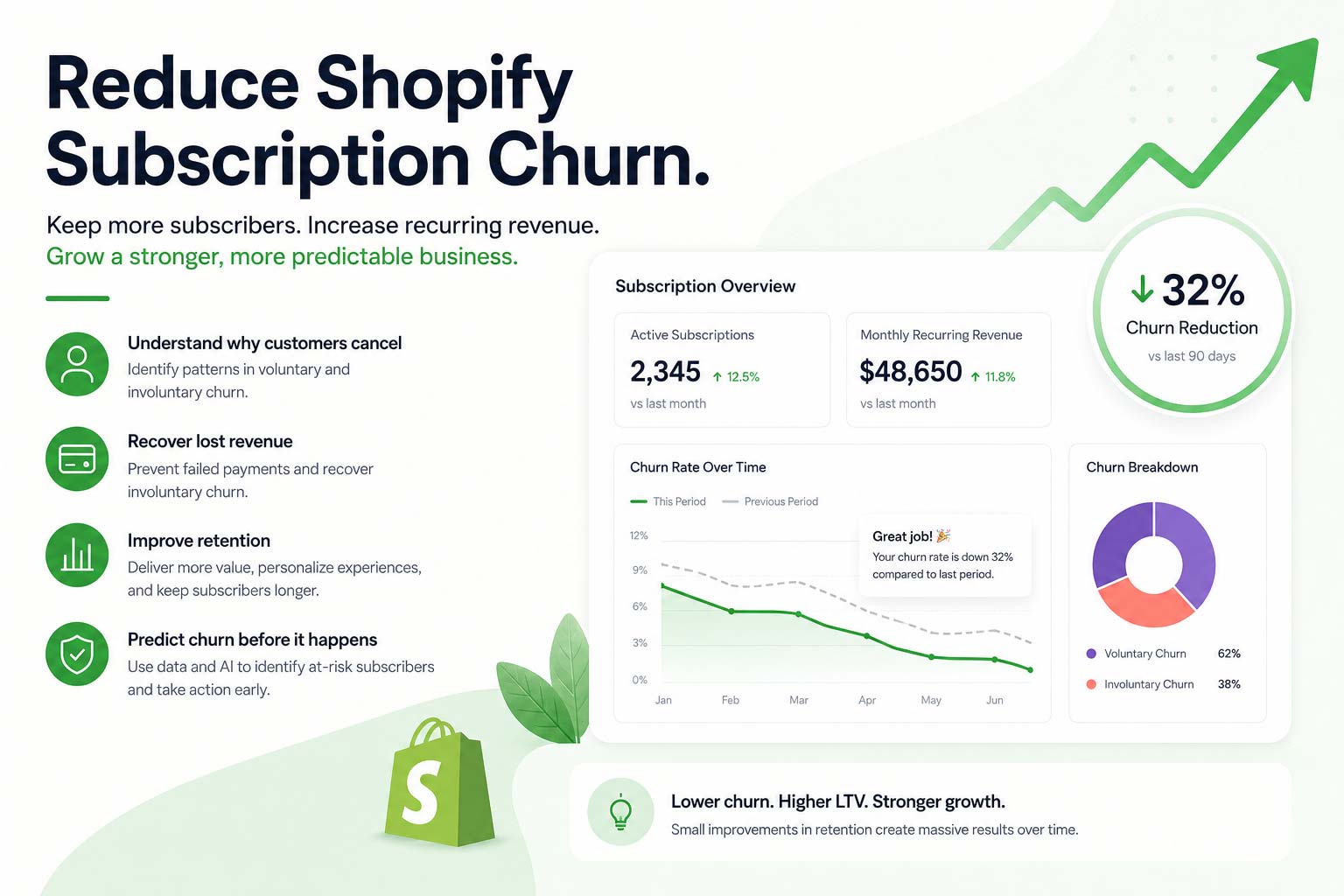
Step 2: Reduce Subscription Churn
Increasing Shopify LTV is impossible if subscribers leave too quickly.
To reduce churn:
- Use cancellation prevention flows
- Offer subscription pauses instead of cancellations
- Recover failed payments automatically
- Provide personalized retention offers
Even small reductions in churn can dramatically improve customer lifetime value because subscribers remain active longer.
Step 3: Increase Average Order Value with Bundles
Another powerful way to improve Shopify LTV is by increasing average order value (AOV).
Product bundles help customers discover complementary products while increasing revenue per transaction.
Effective bundle strategies include:
- Frequently bought together products
- Tiered bundle discounts
- AI-generated personalized bundles
- Subscription bundle offers
Higher order values combined with repeat purchases create exponential lifetime value growth.
Step 4: Personalize the Customer Experience
Personalization is one of the most effective ways to increase retention and repeat purchases.
Personalized experiences may include:
- AI-powered product recommendations
- Behavior-based offers
- Dynamic bundle suggestions
- Targeted retention campaigns
Customers who feel understood are more likely to continue purchasing from your brand long term.
Step 5: Build Long-Term Customer Relationships
Brands with high Shopify LTV focus heavily on relationship-building, not just transactions.
This includes:
- Email education sequences
- Community building
- Loyalty programs
- Consistent post-purchase engagement
Customer lifetime value increases when customers feel connected to the brand beyond individual products.
Step 6: Use AI to Optimize Revenue Automatically
AI is transforming ecommerce retention and revenue optimization.
Modern Shopify merchants increasingly use AI to:
- Predict churn risk
- Recommend personalized bundles
- Generate retention offers
- Identify high-value customers
- Optimize subscription experiences
Instead of relying on manual guesswork, AI systems can continuously optimize customer lifetime value behind the scenes.
Why Shopify LTV Matters More Than Ever
As advertising costs rise across ecommerce, stores with strong customer lifetime value gain a major competitive advantage.
Higher Shopify LTV means:
- You can spend more aggressively on customer acquisition
- Your revenue becomes more predictable
- Your profit margins improve over time
- Your business becomes less dependent on constant new traffic
In many cases, increasing customer lifetime value by even 10–20% can have a larger impact on profitability than dramatically increasing traffic.
The highest-performing Shopify brands understand that sustainable growth comes from maximizing the value of existing customers—not just acquiring new ones endlessly.
Increase Shopify LTV With AI-Powered Revenue Optimization
Improving Shopify LTV requires more than isolated tactics. It requires systems that increase recurring revenue, reduce churn, optimize bundles, and improve customer retention automatically.
That’s where AI-powered ecommerce optimization becomes powerful.
Subscriptions Flow AI helps Shopify merchants increase customer lifetime value through recurring subscriptions, AI-powered churn reduction, personalized retention offers, and subscription optimization tools.
Instead of losing customers after the first purchase, you can build predictable recurring revenue and long-term customer relationships that scale.
If you're serious about increasing Shopify LTV, improving retention, and growing recurring revenue, now is the time to install Subscriptions Flow AI.